
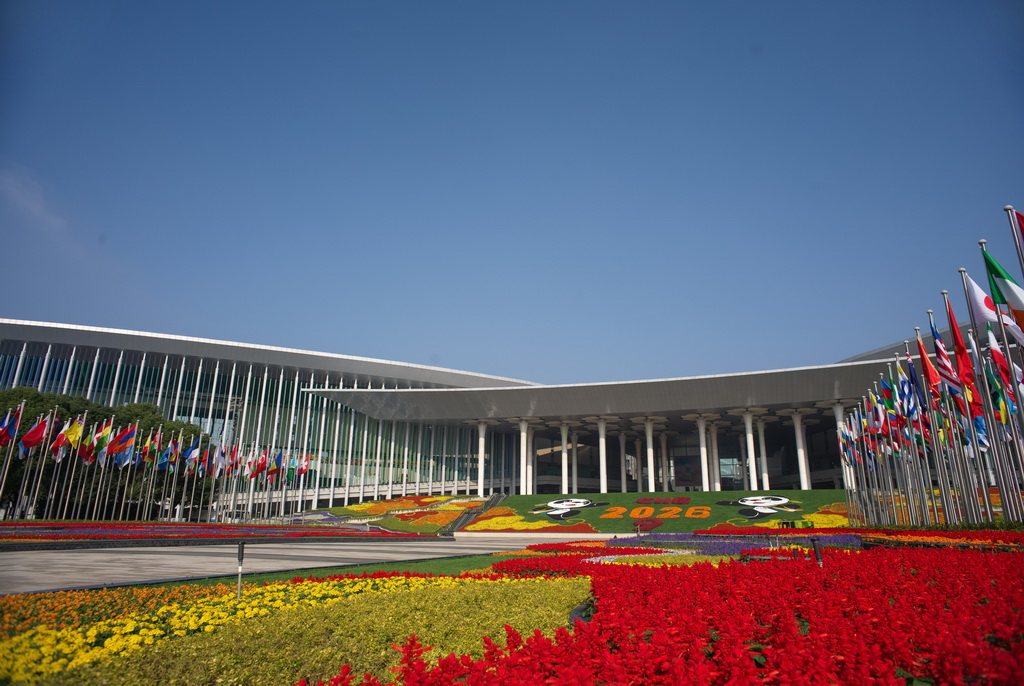
On 5 November, the 9th China International Import Expo opened at the National Exhibition and Convention Center in Shanghai. The show runs six days, through 10 November.
The scale figures are the highest in the expo's history: 162 countries, regions and international organisations taking part, 4,142 overseas companies exhibiting, overall exhibition space exceeding 440,000 square metres for the first time, and the enterprise exhibition alone passing 370,000 square metres for the first time. More than 300 Fortune Global 500 companies and industry leaders are exhibiting, also a first, and more than 2,000 companies are first-time participants.
Those numbers would support a standard opening report. But looking only at floor space and exhibitor counts misses what is actually changing at this expo.
Across nine editions, the measure applied to the CIIE has changed. It used to be how much was signed. Now it is how much stays.
Debuts are no longer decoration; they are a hard indicator
This edition features more than 480 representative global premieres, Asian firsts and China debuts — a record.
The list shows these are not padding. Qualcomm brings a 6G terminal prototype for its global debut. Siemens Healthineers gives an Asian premiere to ARTIS genio floor, a native-AI spectral angiography system whose transfemoral approach can cut device operating time for physicians by 83 per cent. Austria's WFL presents the M35-G turn-mill machining centre, which consolidates turning, milling, drilling and grinding into a single machine, as an Asian first. Michelin shows a tyre made with 75 per cent renewable and recycled materials, with carbon black from end-of-life tyres and silica from rice husks.
The pharma section is more telling. The pharmaceutical zone gathers 12 Fortune Global 500 drugmakers, and 16 of the world's top 20 pharmaceutical companies are present. Unlike previous years, multinational drugmakers are bringing pipelines not yet approved in China — or anywhere — onto the stand. Novartis is giving its immunology candidate Ianalumab a China debut before it even has a Chinese name.
Bringing unapproved products to a debut means the expo's function has shifted: from selling mature products to testing market response. That is only possible when the audience quality is high enough.
The technical equipment zone has also been reorganised, putting semiconductor materials, equipment, design and finished products from across the supply chain into a single hall. The curation logic moved from grouping by country to grouping by chain.
From exhibit to product, the timeline has compressed to hours
Shanghai Customs opened a "CIIE Express" channel for three bonded warehouses — Zhangyuan, Yuyuan and Donghao Lansheng — allowing goods to enter the warehouse on arrival and go on preview immediately, with point-to-point transfer taking as little as 35 minutes. On 2 November, 616 pieces of jewellery worth nearly 15 million yuan moved directly from the Yuyuan bonded warehouse to the National Exhibition and Convention Center for setup.
The three bonded warehouses have declared more than 31 million yuan in exhibit value, up 74.6 per cent year on year.
After facilitation measures for first-launch imported consumer goods took effect, customs clearance time fell from a minimum of seven days to same-day release at the fastest. The measure has helped more than 30,000 debut products reach the market quickly.
Nor does the process stop after the show. Shanghai has built a "6 days plus 365 days" year-round exhibition and sales mechanism, and the Hongqiao Perennial Exhibition Centre now carries more than 85,000 CIIE-identical products from over 6,000 brands in more than 120 countries.
Together these form a complete chain: how long it takes an exhibit to get in, where it goes afterwards, and how it keeps selling. These three stages used to be separate. Now they are connected.
For exhibitors, the test of whether a show is worth attending has shifted from how many customers six days can reach to whether the product has a future in China after those six days.
From exhibitor to investor: the most concrete change of nine years
There are 169 companies and 30 overseas exhibition organisers that have participated in all nine editions.
Sanofi has exhibited for nine consecutive years. This year its Shanghai R&D and Innovation Centre was upgraded, a Beijing insulin API production base with total investment of 1 billion euros began construction, and a China Innovation and Operations Centre was established in Chengdu. Sherry Wang, president of Sanofi Greater China, said China is now Sanofi's second-largest market worldwide.
Elekta is also a nine-time participant. After more than four decades in China, it achieved full domestic production across its product line in 2025. President and CEO Jakob Just-Bomholt said China remains one of the world's most dynamic and attractive markets and an important source of global healthcare innovation.
GE HealthCare's trajectory is the most complete: 38 million yuan of additional investment in its Shanghai diagnostic pharmaceutical base in May 2024; the opening in December 2025 of a Magnetic Resonance Eastern Hemisphere Headquarters R&D and Innovation Centre at its Tianjin base, its only system-level MR R&D centre outside the United States; and in April 2026, the launch of the first end-to-end intelligent CT detector "lights-out" demonstration line at its Beijing imaging equipment manufacturing base. With four R&D and innovation centres in China and more than 1,800 local engineers, the company has brought 200 locally developed products to market, sold in more than 100 countries.
German water treatment brand SYR Hanssler has launched Asian premieres at six consecutive editions. Leveraging the "exhibitor to investor" platform effect, it has set up four "6+365" year-round showrooms across China and built a localised production line in Zhejiang.
Sherwin-Williams offers the clearest contrast: an 80-square-metre stand on its first appearance at the 8th edition, expanded to 180 square metres on its second visit this year.
Bill Anderson, chairman of Bayer's board of management, described the shift: at first the expo was seen mainly as a window for bringing global innovation into China; today it is an important stage in Bayer's global innovation network, with innovation flowing in both directions — global experience into China, and Chinese innovation out to the world.
Shanghai's figures support the trend: in the first eight months of this year, actual foreign investment in the city reached 11.59 billion US dollars, up 6.9 per cent year on year; by August, the cumulative number of regional headquarters of multinational companies and foreign-funded R&D centres had reached 1,120 and 675 respectively.
Lu Shan, vice mayor of Shanghai, said the expo is not merely a trade show for the city but a weighty expression of trust.
The Hongqiao Forum releases a new report
The Hongqiao International Economic Forum, held alongside the expo, takes "Stable Cooperation for an Open World Economy" as its theme this year, with a main forum and 23 sub-forums under a "1+4" structure.
The forum released the Exporting to China Capability Development Report for the first time, alongside the World Openness Report 2026 and the latest World Openness Index — a pair of flagship reports.
The new report deserves a note of its own: it is the world's first research report to survey China's market opportunities and potential from the perspective of trading partners. Previous openness reports mostly explained how China opens. This one explains how others can sell into China — a shift of viewpoint from self to counterpart.
Vice Minister of Commerce Yan Dong described the pair this way: one takes a global stance for shared openness, the other focuses on China for win-win cooperation.
The inclusiveness line got stronger this year
The Asia-Africa Product Zone has been fully upgraded this edition, with free booth space for least developed countries increasing 17 per cent.
Policy backs it up: from 1 May this year, China implemented zero tariffs on 53 African countries with diplomatic relations. Free booths and tariff policy together form a complete channel.
Madagascar's lamb is one example of that channel. By the end of 2025, Madagascar had exported more than 700 tonnes of lamb to China, benefiting more than 1,600 herding households. This year, Malagasy lamb appears at the CIIE for the third time.
The country exhibition has also expanded: 69 countries and international organisations are taking part, with Canada and Sri Lanka as guest countries of honour, and Moldova, Romania, Seychelles, Gabon, Somalia and the United Nations Development Programme participating for the first time.
Robert Mitrofan, chief representative in China of the Romanian Chamber of Commerce and Industry, said this is the first time Romania has appeared at the CIIE in the form of a national pavilion — "not just one more stand, but the first time a national image has walked through China's open door". The chamber has opened a Shanghai office, with the goal of moving from short-term participation to long-term operation.
A new measure
Looking back across nine editions: the 8th CIIE recorded 83.49 billion US dollars in intended deals on an annualised basis, up 4.4 per cent, and the first eight editions together exceeded 580 billion US dollars.
That is a large enough number. But what is worth recording about this edition may not be the deal value but several finer indicators.
Customs clearance falling from seven days to same-day release is the speed at which 30,000 debut products reach the market.
The 169 companies present at all nine editions are the stock of trust.
The more than 2,000 first-time exhibitors are the flow of trust.
The 17 per cent increase in free space for least developed countries is the quality of openness.
In the first nine months of this year, China's imports reached 16.7 trillion yuan, up 22.3 per cent year on year — the fastest growth since 2021.
The greatest risk for a show in its ninth year is becoming an annual ritual. The CIIE has not become one, because it has solved a new problem each year: in the first year, whether it could be held at all; in the middle years, whether it could be made big; and at this stage, whether it can make things stay.
Whether exhibits can become products, whether exhibitors can become investors, whether six days can become 365.
The answers to those three questions are the 9th CIIE's real report card.