
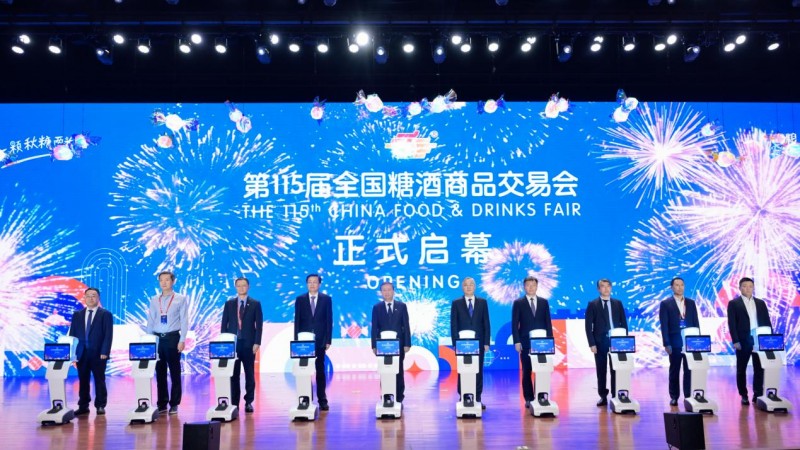
On October 15, the 115th National Sugar and Wine Trade Fair opened at the Nanjing International Expo Center. The opening ceremony was attended by leaders from the Ministry of Commerce, the Jiangsu Provincial Government, the Nanjing Municipal Government, and COFCO, alongside representatives from national industry associations, foreign institutions in China, international chambers of commerce, key research institutes, leading industry enterprises, distributors, buyers, and the media. Hosting two sessions of the Trade Fair in Nanjing within two years marks another successful practice of central-local collaboration and high-level opening-up, while also presenting new opportunities for exchange and cooperation in the food and beverage sectors and boosting the consumer market.
For the first time, this year's Trade Fair has been included in the Ministry of Commerce's annual "Export to China" campaign roster. A dedicated "Export to China" exhibition zone was established to introduce premium global products to the Chinese market, connecting "China's sweetness" with the "sweetness of the world." Exhibitors from 31 source countries across 16 countries and regions gathered to showcase coffee, confectionery, ready-to-eat meals, dairy products, and a variety of authentic global flavors in Nanjing.
According to Shi Dongyan, Secretary-General of the Trade Fair's Organizing Committee and Chairman of COFCO Exhibition, a total of 12 countries are participating in the fair for the first time: Pakistan, Iran, Sri Lanka, and the five Central Asian nations from Asia; Belarus and Slovakia from Europe; Ethiopia from Africa; and the Dominican Republic from the Americas. A wide array of overseas products, including gin, infused liqueurs, plant-based protein beverages, dairy drinks, health and wellness beverages, rice crackers, and nutritional supplements, are entering the Chinese market for the first time. Bringing their freshest offerings, global exhibitors are turning the fair into a "golden bridge" for trade cooperation.
Using food as a medium to build cross-border bridges of communication, the Trade Fair is painting a vivid picture of "connected trade and integrated livelihoods." At the concurrent "Global Food Shopping Festival," Canadian icewine and Quebec maple syrup emerged as bestsellers. The sweetness of icewine comes from grapes harvested and naturally frozen at temperatures below -8°C, requiring about 8 kilograms of grapes to produce just 375 milliliters of icewine. The sweetness of maple syrup is the result of prolonged boiling, requiring roughly 10 liters of maple sap to yield just 1 liter of syrup. Marveled Mr. Li, a Nanjing resident: "I used to only enjoy these treats when traveling abroad; I never expected to buy such authentic delicacies right on my doorstep now."
On one side, participating countries and enterprises are arriving from near and far, bustling to set up their booths; on the other, domestic buyers and consumers are eagerly poised, ready to hit the "confirm" button on their orders. Having closely followed the event schedule in advance, Zhang Ya from Nanjing Jiayu Food Trading Co., Ltd. is eager to leverage the momentum of the Trade Fair to introduce more niche overseas product categories into the domestic market. Yan Renji, operator of the Wuxi food brand "Aqun · Chenglijia," is equally enthusiastic: "Our goal this year is to source more products in the health and wellness sector at the Trade Fair, with a targeted procurement volume of 500,000 to 1 million RMB." Meanwhile, Wu Zhiliang, head of Hunan Heliang Ruiyun Food Trading Co., Ltd., has allocated a dedicated procurement budget of 10 million to 20 million RMB, looking forward to discovering new products on-site, engaging face-to-face with source suppliers, and expanding distribution channels and partnerships.
Placing equal emphasis on exhibitions and conferences, the "Export to China" Sugar and Wine Industry Matchmaking Conference was held on October 15 at the Nanjing International Conference Center as a flagship event of the "Export to China" initiative. Co-organized by the Foreign Trade Development Bureau of the Ministry of Commerce, the Trade Fair's Organizing Committee, and the Yangtze River Delta International Chamber of Commerce Alliance, the event drew around 50 overseas institutions and imported food enterprises, along with approximately 150 distributors and procurement representatives. The venue featured themed zones for exhibition, tasting, and trade matching. Prior to the event, information collection and intent matching were conducted based on the needs of both suppliers and buyers. On-site, overseas institutions and brand owners engaged in face-to-face negotiations with domestic purchasers, driving cooperation down to specific products, specific channels, and concrete orders, ensuring that premium overseas products not only "enter China" but also "take root and thrive in the Chinese market."
Nanjing's logistical corridors are also accelerating the delivery of global delicacies. Since the beginning of this year, as Jiangsu Province's largest hub for perishable imports, Nanjing's air cargo hub has continuously expanded its global import channels. New dedicated all-cargo flight routes to Kota Kinabalu, Malaysia, and Oslo, Norway, have been launched to precisely connect with premium overseas production bases. These routes prioritize the import of perishables such as Southeast Asian durians and Norwegian chilled salmon, ensuring that more global delicacies hit the domestic market at peak freshness.
As Jiangsu's "aerial gateway," Nanjing Lukou International Airport also serves as a vital strategic hub for the province's high-level opening-up. Data shows that in the first half of this year, the airport's international and regional cargo and mail throughput reached 64,000 tons, a year-on-year increase of 37.1%. Notably, the customs-cleared volume of imported fresh fruit surged 44-fold year-on-year. From January to August, the total cargo handling volume at the designated supervision area for inbound perishables reached 3,391 tons. Volumes across all categories of imported perishables saw substantial growth, with salmon imports alone reaching 1,327 tons.
As logistical corridors grow ever more extensive and avenues for cooperation increasingly broad, the "golden channels" for global trade continue to accelerate. With an increasingly open embrace, Nanjing is welcoming the world and connecting with the globe.